
QR Code Scams Are Rising — Here's How to Stay Safe
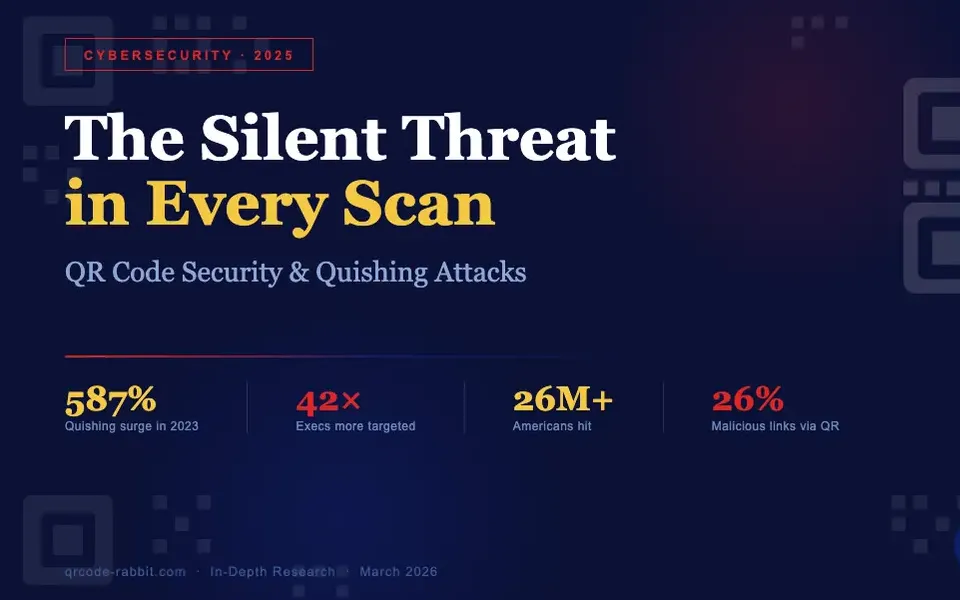
Cybersecurity · 2025
The Silent Threat in Every Scan: QR Code Security & Quishing
In-Depth Analysis · ~1,100 words · Attacks, Vulnerabilities & Defense
You've scanned them on menus, parking meters, and product labels without a second thought. But that tiny grid of black and white squares has quietly become one of cybercriminals' most effective weapons — and most people don't see it coming.
From Convenience to Vulnerability
QR codes were invented in 1994 to track automotive parts. Three decades later, they're everywhere — embedded in emails, plastered on utility bills, and printed on restaurant tables. Global QR code scans quadrupled to 41.77 million by 2025, and with that explosive adoption came an equally explosive security problem.
The fundamental design flaw is deceptively simple: a QR code hides its destination. Unlike a clickable hyperlink — where a careful user can hover and preview the URL — a QR code is an opaque image. You don't know where it leads until you've already gone there. Attackers have weaponized this blind spot into an entirely new category of cyberattack called "quishing" — QR code phishing.
587% | 42× |
|---|---|
Increase in quishing incidents in 2023 alone | More likely C-suite executives are targeted vs other employees |
26M+ | 26% |
|---|---|
Americans already directed to malicious sites via QR codes | Of all malicious links are now delivered through QR codes |
Anatomy of a Quishing Attack
Unlike brute-force hacks, quishing is a masterclass in social engineering. The attack typically unfolds in four calculated steps:
1 | Lure Creation : Attackers generate a malicious QR code encoding a hostile URL — often via URL shorteners or legitimate redirect services like Google links to disguise the true destination. |
2 | Delivery : The code is delivered via email (often embedded in PDF attachments), physical stickers on public kiosks, parking meters, or even unsolicited packages mailed to targets. |
3 | The Pivot : When the victim scans with their smartphone, they leave the protected corporate network and move to an unmanaged mobile device — entirely outside email filters, endpoint protection, and MDM visibility. |
4 | Harvest : The victim lands on a spoofed login page — impersonating Microsoft, DocuSign, or an HR portal — and unknowingly surrenders credentials, MFA tokens, or financial data. |
Why It Bypasses Traditional Defenses
What makes quishing particularly dangerous isn't just its prevalence — it's the structural reasons why existing security infrastructure fails against it:
→ Image-based evasion: Email security gateways scan text and links, not images. A QR code is just pixels — there's no URL for the scanner to evaluate until the code is decoded.
→ Mobile-first blind spot: Corporate security perimeters protect desktops and managed devices. The moment a user picks up their personal phone to scan, they're operating outside every layer of enterprise protection.
→ Implicit trust: People have been conditioned to trust QR codes. When one appears on what looks like an official HR email or a physical sign at a trusted location, scrutiny drops to near zero.
→ Redirect obfuscation: Advanced attackers use legitimate services — Google redirects, Cloudflare Turnstile — to appear safe to automated crawlers while still routing victims to phishing pages.
"Unlike a URL in plain text, QR codes don't lend themselves to scrutiny. The destination appears only for a few seconds in the camera app — and threat actors use redirection techniques that conceal the final destination entirely." — Sophos Security Research Team
The Evolving Threat Landscape (2024–2025)
QR codes in PDF attachments: Attackers began embedding codes in PDF attachments rather than email bodies to evade detection. Over 500,000 such emails were detected in a single three-month period in 2024 — impersonating DocuSign and Microsoft voicemail notifications.
Nested and split QR codes: One of the most sophisticated tactics involves embedding a malicious QR code inside or around a legitimate one. The outer code points to a phishing URL; the inner code leads to Google — making automated detection extremely difficult.
Phishing-as-a-Service (PhaaS) integration: Platforms like Tycoon 2FA and Greatness now include QR code generation as a standard feature, enabling even low-skill attackers to launch credential-harvesting campaigns that capture both passwords and MFA tokens.
Nation-state exploitation: Beyond financial crime, intelligence agencies have reportedly used QR codes to compromise messaging accounts of military personnel and distribute Remote Access Trojans (RATs) — giving attackers silent, persistent device access.
How to Defend Against Quishing
🔍 Preview Before You Scan Always check the URL preview shown by your camera app before tapping. Reject codes using shortened URLs or unfamiliar domains. | 🛡️ Enforce MFA on Every Account Even if credentials are stolen, MFA provides an additional layer. Use hardware keys or authenticator apps over SMS-based MFA. |
📱 Use a Secure QR Scanner Security-focused QR scanners analyze the destination URL before loading, blocking malicious redirects at the point of scan. | 🧠 Train Employees Regularly Run simulated quishing drills. Teach the "pause-verify-report" habit — if any message demands a QR scan with urgency, treat it as a red flag. |
📧 Deploy Multimodal Email Filtering Next-gen email security uses OCR and AI to render PDF attachments, extract QR codes visually, and analyze the destination URL before delivery. | 🔒 Never Scan Unexpected Codes Unsolicited packages, surprise emails, or QR stickers placed over existing signs are major red flags. When in doubt, navigate directly via a browser. |
The Road Ahead
The security industry is responding. Researchers are developing "smart" QR codes with built-in authentication — like the SDMQR (Self-Authenticating Dual-Modulated QR) — that cryptographically verify a code's integrity before revealing its destination. AI-powered email filters are getting better at detecting QR codes in attachments, and major smartphone manufacturers are building enhanced preview features directly into camera apps.
But the arms race continues. As defenses improve, attackers adapt — nesting codes, hijacking legitimate redirects, and using AI to craft more convincing lure emails free of the grammatical errors that once made phishing easy to spot.
The QR code isn't going anywhere — it's woven too deeply into commerce, communication, and daily life. The only sustainable defense is awareness: understanding that the same simplicity that makes QR codes so useful also makes them perfectly suited to deception. Every scan is a small act of trust. Make sure it's deserved.
Research sourced from Barracuda Networks, Sophos, Recorded Future, Keepnet Labs, Palo Alto Unit 42, CyberProof & CNBC · March 2026
Related Articles
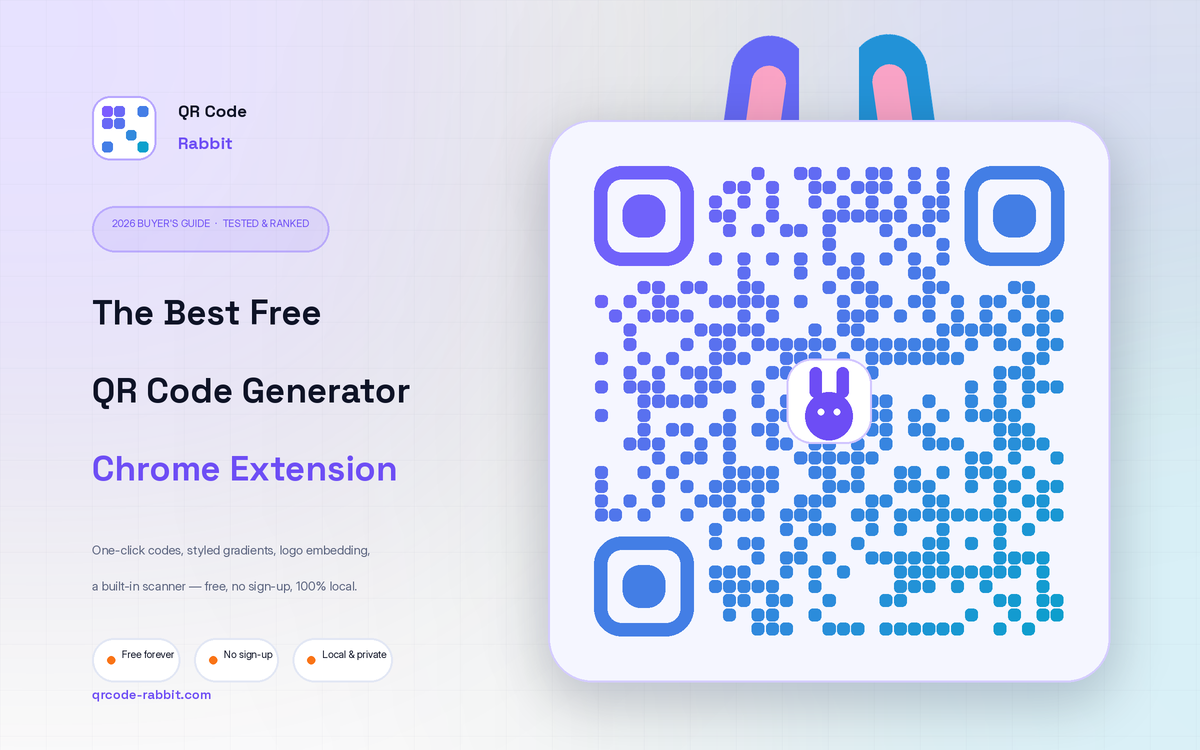
Best Free QR Code Generator Chrome Extension (2026 Guide)
The best free QR code generator Chrome extension in 2026, tested and ranked. Styled gradients, logo embedding, a built-in scanner and PNG/SVG export — no sign-up, 100% local. See why QR Code Rabbit wins.
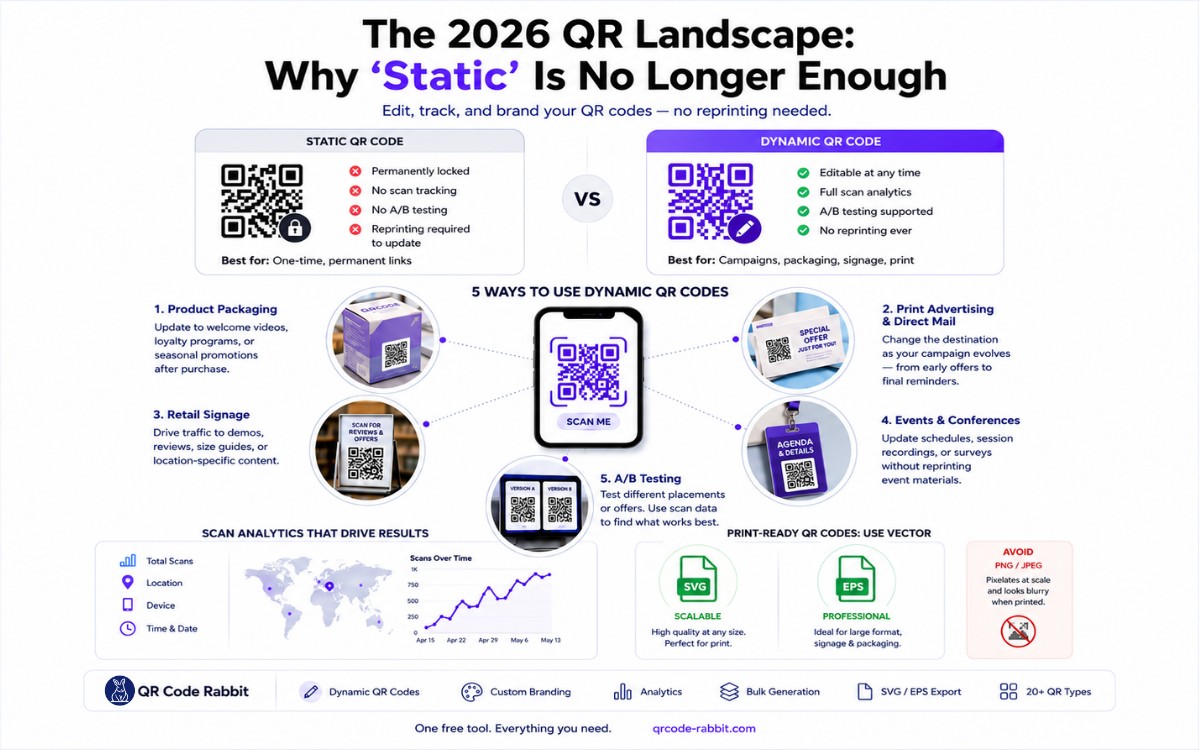
The 2026 QR Landscape: Why 'Static' is No Longer Enough
Learn how to create free dynamic QR codes that you can edit, track, and brand — no reprinting needed. QR Code Rabbit gives you everything in one free tool. Updated April 2026.
What You Will Find on the QR Code Rabbit Blog
We publish practical guides, plain-language explainers, and occasional news about QR adoption and security. The audience is shop owners, marketers, teachers, and developers who use QR codes in real projects — not theory for its own sake.
How-to articles
Step-by-step pieces for menus, badges, packaging, forms, UPI labels, and social profiles. Most include sizing tips and a short testing checklist.
Knowledge base posts
Capacity limits, error correction, static vs dynamic architecture, and how scan tracking works — written so non-developers can follow, with enough depth for integrators.
News and security
Retail and fintech adoption stories, product updates, and reminders about quishing and safe scanning habits as QR usage grows.
Resources and templates
Campaign checklists, design consistency notes, and pointers for teams rolling QR out to many locations or via API.
New posts regularly
Browse by category — how-to, knowledge base, news, resources — or read everything on the main blog index. No paywall, no login required.