
Bitcoin QR Code Generator: Complete Guide to Dynamic BTC Payments (2026)
Generate a Bitcoin QR code free in 60 seconds. Learn how BIP-21 works, static vs dynamic codes, crypto campaign tracking, and security best practices. Powered by QR Code Rabbit
.webp)
Bitcoin QR Code Generator: The Complete Guide to Accepting BTC Payments in 2026
Last updated: April 14, 2026 | 9 min read
A Bitcoin wallet address is between 26 and 42 characters long. One mistyped character can permanently misdirect a payment — with no way to reverse it. That is the problem a Bitcoin QR code solves. It encodes your wallet address into a scannable image, so any crypto wallet app reads it perfectly every single time.
This guide covers everything: how Bitcoin QR codes work technically, the BIP-21 payment standard, when to use static versus dynamic codes, how to run trackable crypto campaigns, and how to stay secure — all powered by QR Code Rabbit's free Bitcoin QR code generator.
What Is a Bitcoin QR Code?
A Bitcoin QR code is a two-dimensional barcode that encodes a Bitcoin wallet address — along with optional payment parameters like an amount, a label, and a message — into a scannable image. When someone scans it with a crypto wallet app, the payment destination and amount are filled in automatically. No typing. No copy-paste errors.
Bitcoin addresses are 26 to 42 characters depending on the format. A single typo in a manually entered address sends funds to either a wrong wallet or a permanently lost address — and Bitcoin transactions cannot be reversed. QR codes reduce manual entry errors to effectively zero.
₿ Did you know? Over $1.3 trillion in Bitcoin changes hands annually. Even a fraction-of-a-percent error rate from manual address entry represents a staggering volume of misdirected payments. QR codes are the standard solution used by every professional crypto business operating today.
Bitcoin Address Formats Supported by QR Codes
| Format | Prefix | Type | Notes |
|---|---|---|---|
| Legacy | Starts with 1 |
P2PKH | Widest wallet compatibility, higher fees |
| SegWit P2SH | Starts with 3 |
P2SH | Lower fees, backwards compatible |
| Native SegWit ★ | Starts with bc1q |
Bech32 | Lowest fees, most efficient. Recommended. |
| Taproot | Starts with bc1p |
P2TR | Enhanced privacy, growing adoption |
QR Code Rabbit validates the checksum of all four formats in real time before generating your code, so invalid addresses are caught before they cause problems.
How Bitcoin QR Codes Work
At a technical level, a Bitcoin QR code follows the ISO/IEC 18004 standard, encoding a plain URI string using Reed-Solomon error correction. The URI follows the BIP-21 scheme (covered in the next section). The error correction level determines how much of the code can be damaged or obscured while still scanning reliably.
The End-to-End Payment Flow
- A merchant or individual generates a QR code encoding their wallet address and optional payment amount.
- The payer opens their crypto wallet app and points the camera at the code.
- The wallet reads the BIP-21 URI and auto-fills the destination address and amount.
- The payer reviews and confirms. The transaction is broadcast to the Bitcoin network.
- Confirmation typically arrives within 10 minutes for standard fee transactions.
QR Code Error Correction Levels
| Level | Recovery Capacity | Best Used For |
|---|---|---|
| L — Low | 7% damage recovery | Clean digital screens only |
| M — Medium | 15% damage recovery | General-purpose default |
| Q — Quartile ★ | 25% damage recovery | Bitcoin QR codes with an embedded logo |
| H — High ★ | 30% damage recovery | Physical print, outdoor, or harsh environments |
Always use Q or H error correction when adding a logo to your Bitcoin QR code. The logo covers part of the code's data area — higher error correction ensures the code still scans perfectly despite that.
The BIP-21 URI Standard Explained
BIP-21 (Bitcoin Improvement Proposal 21) defines the URI format that all Bitcoin QR codes follow. It is the specification that tells every wallet app — regardless of brand or platform — how to parse a Bitcoin payment request from a QR code. It standardizes the address, amount, label, and message fields into one structured string.
BIP-21 URI Structure
bitcoin:ADDRESS?amount=AMOUNT&label=LABEL&message=MESSAGE| Parameter | Required? | Description | Example |
|---|---|---|---|
ADDRESS |
✅ Required | The Bitcoin wallet address to receive funds | bc1qar0s... |
amount |
Optional | Payment amount in BTC | 0.005 |
label |
Optional | Payee name visible to the sender | QR Code Rabbit |
message |
Optional | Payment memo or reference | Invoice #1042 |
Real-World BIP-21 Example
bitcoin:bc1qar0srrr7xfkvy5l643lydnw9re59gtzzwf5mdq?amount=0.005&label=QRCodeRabbit&message=Invoice%20%231042When a wallet app scans this code, it automatically fills in the destination address, sets the payment to 0.005 BTC, names the payee "QRCodeRabbit," and pre-fills "Invoice #1042" as the memo. The payer simply reviews the details and confirms.
Important: The
amountfield is always denominated in BTC, not fiat. If you need the payment amount to reflect a live fiat price — for example, "charge exactly $50 USD worth of BTC at today's rate" — use a dynamic QR code with a redirect to a payment page that handles real-time conversion.
Static vs. Dynamic Bitcoin QR Codes: Which One Do You Need?
This is the most important technical decision any Bitcoin user or business makes when setting up QR-based payments. The choice determines whether you can update payment details later, track campaign performance, or respond to a security incident without replacing every piece of printed material you have.
| Feature | Static Bitcoin QR Code | Dynamic Bitcoin QR Code |
|---|---|---|
| How it works | BTC address encoded directly into the QR pattern | QR points to a short URL that redirects to the BTC address |
| Edit after printing | ❌ Impossible | ✅ Update destination anytime |
| Scan analytics | ❌ None | ✅ Location, device, time-of-day |
| Live fiat conversion | ❌ Fixed BTC amount only | ✅ Redirect to live-rate payment page |
| Disable if compromised | ❌ Cannot be deactivated | ✅ Disable instantly from dashboard |
| Address rotation | ❌ New code required each time | ✅ Rotate addresses without reprinting |
| Works offline | ✅ No internet required to scan | ⚠️ Redirect requires connectivity |
| Best for | One-time payments, cold storage | Merchants, events, campaigns, ongoing use |
⚡ Privacy advantage of dynamic codes: Bitcoin best practice is to never reuse a wallet address — each transaction should go to a fresh address to prevent linking your payment history. With a dynamic QR code, you can rotate your receiving address after every transaction without reprinting a single flyer, label, or sign. Static QR codes make address rotation operationally impossible at scale.
Create a dynamic Bitcoin QR code free →
Who Uses Bitcoin QR Codes?
Bitcoin QR codes are not a niche tool. They span retail, hospitality, freelancing, nonprofits, events, and content creation — anywhere that accepting BTC payments needs to be fast, reliable, and error-free.
Common Use Cases by Audience
| Audience | Recommended QR Type | Primary Use Case | Key Benefit |
|---|---|---|---|
| Retail & e-commerce | Dynamic | Checkout — in-store & online order pages | No bank fees, instant settlement |
| Cafés & restaurants | Dynamic | Table QR for tips or full bill payment | Switch amounts per table from the dashboard |
| Freelancers | Static or Dynamic | Embedded in PDF invoices | No PayPal fees, no chargeback risk |
| Nonprofits & charities | Dynamic | Fundraising materials, donation drives | Accept global BTC with zero intermediary |
| Event & conference organizers | Dynamic | Tickets, merch, sponsor payments | Scannable at scale on screens and badges |
| Content creators | Dynamic | YouTube/stream overlay for viewer tips | Rotate address monthly for privacy |
Understanding your audience also shapes how you present the QR code. Crypto-native users will scan without friction — they recognize the format immediately. Mainstream audiences often need fiat context to feel comfortable, such as a label reading "$5.00 ≈ 0.000074 BTC," to understand what they are paying before they confirm.
How to Generate a Bitcoin QR Code in 60 Seconds
QR Code Rabbit's Bitcoin QR code generator requires no account for static codes and takes under a minute from start to download.
Step-by-Step: Create Your BTC QR Code
-
Open the Bitcoin QR Generator.
Go to qrcode-rabbit.com/crypto. No login required for a static code. For a dynamic code with analytics and editing, create a free account. -
Paste your Bitcoin wallet address.
Enter yourbc1q...,3..., or1...address. QR Code Rabbit validates the checksum in real time — if the address contains an error, you are alerted before the code is generated. -
Set optional BIP-21 parameters.
Add a BTC amount, a label (your name or business), and a payment message such as "Invoice #1042." These fields populate automatically in the payer's wallet when they scan. -
Choose static or dynamic.
For a one-time use: static is sufficient. For an ongoing business, campaign, or any situation where you will need to update the address or track performance: choose Dynamic. -
Customize your design.
Upload your logo, choose brand colors, and set error correction to Q or H. For print use, export as SVG or EPS. For web and email, export as high-resolution PNG. -
Download and deploy.
Your QR code is ready. Test it on at least two different wallet apps before printing or publishing.
→ Generate your Bitcoin QR code free now
Dynamic QR Codes for Crypto Campaigns
A dynamic Bitcoin QR code is not just a payment tool — it is a measurable marketing channel. Every scan generates a data point: timestamp, device type, city, and traffic source. Combined with the ability to update the destination URL at any time, dynamic Bitcoin QR codes make physical and digital crypto campaigns as measurable as any paid ad.
Advanced Dynamic QR Strategies
Address Rotation for Privacy
Update your receiving address weekly or per invoice from the QR Code Rabbit dashboard without touching any printed material. This follows Bitcoin's core privacy recommendation: never reuse addresses across transactions.
Geo-Analytics: Know Exactly Who Scanned
Filter scan data by city, country, or device type. For multi-location businesses or campaigns running across multiple publications, geo-analytics reveal which placements are actually driving payment intent — and which are being ignored.
Time-Limited Payment QR Codes
Set an expiry date for flash sales, NFT drops, or event-only pricing. After the deadline, the QR redirects to a "sale ended" page automatically. No manual intervention required, and no risk of someone scanning an expired offer days later.
A/B Testing Physical Placements
Run two QR Code Rabbit codes on different versions of a flyer, banner, or shelf display — identical destination, different physical placements. Scan volume per code reveals which location converts better, giving you data to optimize print placement the same way you would optimize a digital ad.
Password-Protected Payment Links
Require a passcode before revealing the wallet address. Useful for private fundraising rounds, VIP donor campaigns, or any situation where you need to restrict payment access to a specific audience.
Marketing Channels Where Bitcoin QR Codes Perform Best
- Print advertising — Magazine ads, billboards, and flyers. Dynamic QR lets you measure ROI per publication, comparing scan volume directly against print spend.
- Email newsletters — Embed a Bitcoin QR as an image for direct donations or product payments without redirecting to a checkout page.
- Social media profiles — Add a QR to your link-in-bio for tips, sponsorships, or product sales.
- Video content — Flash a QR during a live stream or in a YouTube card. Measure viewer-to-supporter conversion rate using scan timestamps.
- Product packaging — Add a BTC payment QR to subscription box inserts or merchandise hang tags for frictionless repeat purchases.
Crypto Campaign Performance Benchmarks
| Metric | Industry Benchmark |
|---|---|
| Crypto users who prefer QR over typed addresses | 73% |
| Conversion rate improvement with QR-enabled checkout | 3.2× higher vs. manual address entry |
| Average time from scan to transaction broadcast | Under 8 seconds |
Create a free account to access campaign analytics →
Security & Best Practices for Bitcoin QR Codes
Bitcoin transactions are irreversible. A payment sent to the wrong address cannot be recalled, refunded, or disputed. Security is not a secondary concern with Bitcoin QR codes — it is the primary one.
The QR Code Swapping Attack
The most common physical attack involves replacing a legitimate printed QR code with a sticker encoding a different wallet address. A customer scans what appears to be the correct code and unknowingly sends funds to an attacker's wallet.
Dynamic QR codes mitigate this risk. Because the QR pattern routes through a signed short URL, any tampered code will fail signature validation — the redirect does not execute, and the scan fails rather than succeeding silently with a wrong address.
Best Practices for QR Code Creators
- Use H-level error correction for all physical QR codes.
- Add your logo to the center of the code — it makes swapping or copying harder to execute convincingly.
- Use a dynamic QR code so you can disable a compromised code instantly from your dashboard.
- Display the first 8 and last 6 characters of the wallet address as visible text below the QR code, so customers can manually verify before confirming.
- Never distribute payment QR codes through untrusted channels or third-party redirects.
Best Practices for QR Code Scanners (Payers)
- Always review the full destination address your wallet pre-fills before confirming any payment.
- For any transaction over a small amount, send a test micro-transaction first and verify receipt.
- Never scan Bitcoin QR codes from unsolicited messages, unknown emails, or unverified social media posts.
- Manually compare at least the first 10 and last 6 characters of the displayed address against any reference provided by the merchant.
- Use a wallet with built-in address verification features — most reputable wallet apps include this.
Bitcoin QR Codes and Crypto Marketing: The Bigger Picture
The intersection of QR codes and cryptocurrency is one of the fastest-growing segments in digital payments. As Bitcoin adoption expands into mainstream commerce, the ability to generate professional, trackable, branded Bitcoin QR codes is becoming a standard marketing competency — not a technical specialty.
The most effective crypto marketers treat Bitcoin QR codes the same way they treat landing page URLs: as a measurable conversion point with a specific audience, a specific channel, and a specific outcome to optimize. A well-configured dynamic Bitcoin QR code on a product page can tell you more about payment intent than almost any digital ad metric.
QR Code Rabbit's Bitcoin QR generator is built for this use case — from BIP-21 validation and branded design to real-time scan analytics and campaign-level reporting — all accessible from a single dashboard at qrcode-rabbit.com.
If you also accept UPI payments, QR Code Rabbit supports UPI QR code generation with the same design, analytics, and dynamic redirect features — so your entire payment QR infrastructure lives in one place.
Frequently Asked Questions
Is it safe to share a Bitcoin QR code publicly?
Yes. A Bitcoin wallet address is public by design. Sharing your QR code only allows others to send BTC to you — it never exposes your private key or allows any form of withdrawal. It is fundamentally different from sharing a bank account number. The only privacy consideration is that on-chain transactions are publicly visible on the blockchain, which is why address rotation is recommended for high-frequency payment use.
Can I include a payment amount in a Bitcoin QR code?
Yes. The BIP-21 standard supports an optional amount parameter denominated in BTC (for example, 0.005 for five thousandths of one Bitcoin). Most wallet apps display the equivalent fiat value automatically. If you need the amount to reflect a live fiat price at the moment of scanning, use a dynamic QR code that redirects to a payment page with real-time conversion.
Do Bitcoin QR codes work with the Lightning Network?
Standard BIP-21 QR codes handle on-chain Bitcoin transactions. Lightning Network payments use BOLT-11 invoice QR codes, which follow a different format. Some modern wallet apps support unified QR codes that automatically detect whether a payment should be routed on-chain or via Lightning — check your wallet documentation for support details.
Can I use a Bitcoin QR code on printed materials?
Yes. Set error correction to H-level (30% damage recovery) and export at a minimum of 300 DPI. The smallest reliable print size is approximately 2 cm × 2 cm — below that, camera autofocus becomes unreliable. With a dynamic Bitcoin QR code from QR Code Rabbit, you can update the wallet address at any time after printing without changing the code itself.
Is QR Code Rabbit's Bitcoin QR code generator free?
Yes. Static Bitcoin QR codes are completely free with no account required — just go to qrcode-rabbit.com/crypto and generate. Dynamic QR codes with analytics, editable destinations, and advanced customization are available on paid plans. Full plan details are on the pricing page.
What Bitcoin address formats does QR Code Rabbit support?
QR Code Rabbit supports all four major formats: Legacy (P2PKH, starting with 1), SegWit P2SH (starting with 3), Native SegWit Bech32 (starting with bc1q), and Taproot (starting with bc1p). Address checksums are validated in real time before the code is generated.
Generate Your Bitcoin QR Code Free — No Account Required
Whether you need a one-time static code for a PDF invoice or a dynamic, trackable, branded code for a full crypto campaign, QR Code Rabbit handles it in under 60 seconds.
- ✅ BIP-21 compliant with real-time address validation
- ✅ Supports Legacy, SegWit, Bech32, and Taproot addresses
- ✅ Full brand customization — logo, colors, shapes
- ✅ SVG and EPS vector export for print
- ✅ Scan analytics included on all dynamic codes
- ✅ No account needed for static codes
→ Create your free Bitcoin QR code now | Sign up free for dynamic codes →
Related Articles
Best Free QR Code Generator Chrome Extension (2026 Guide)
The best free QR code generator Chrome extension in 2026, tested and ranked. Styled gradients, logo embedding, a built-in scanner and PNG/SVG export — no sign-up, 100% local. See why QR Code Rabbit wins.
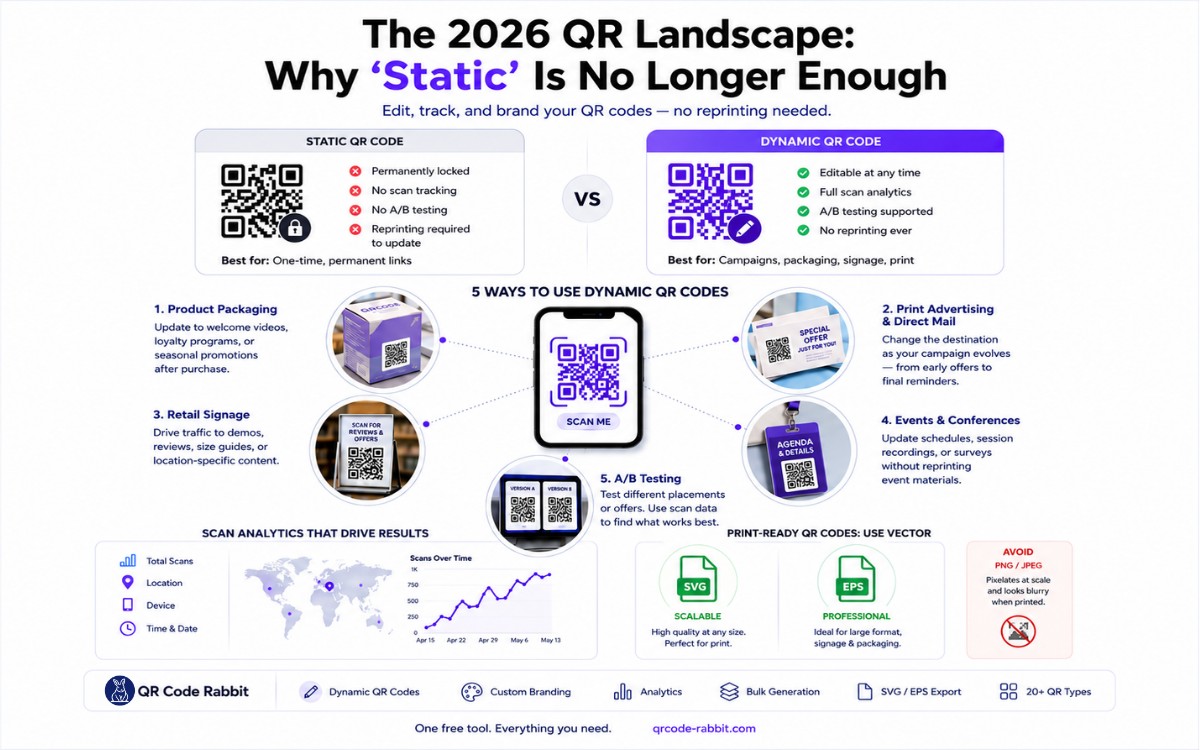
The 2026 QR Landscape: Why 'Static' is No Longer Enough
Learn how to create free dynamic QR codes that you can edit, track, and brand — no reprinting needed. QR Code Rabbit gives you everything in one free tool. Updated April 2026.
What You Will Find on the QR Code Rabbit Blog
We publish practical guides, plain-language explainers, and occasional news about QR adoption and security. The audience is shop owners, marketers, teachers, and developers who use QR codes in real projects — not theory for its own sake.
How-to articles
Step-by-step pieces for menus, badges, packaging, forms, UPI labels, and social profiles. Most include sizing tips and a short testing checklist.
Knowledge base posts
Capacity limits, error correction, static vs dynamic architecture, and how scan tracking works — written so non-developers can follow, with enough depth for integrators.
News and security
Retail and fintech adoption stories, product updates, and reminders about quishing and safe scanning habits as QR usage grows.
Resources and templates
Campaign checklists, design consistency notes, and pointers for teams rolling QR out to many locations or via API.
New posts regularly
Browse by category — how-to, knowledge base, news, resources — or read everything on the main blog index. No paywall, no login required.