

How to Create a Menu QR Code for Restaurants (Step by Step)
Pick PDF or URL, design it, size it for the table, and update your menu without reprinting.
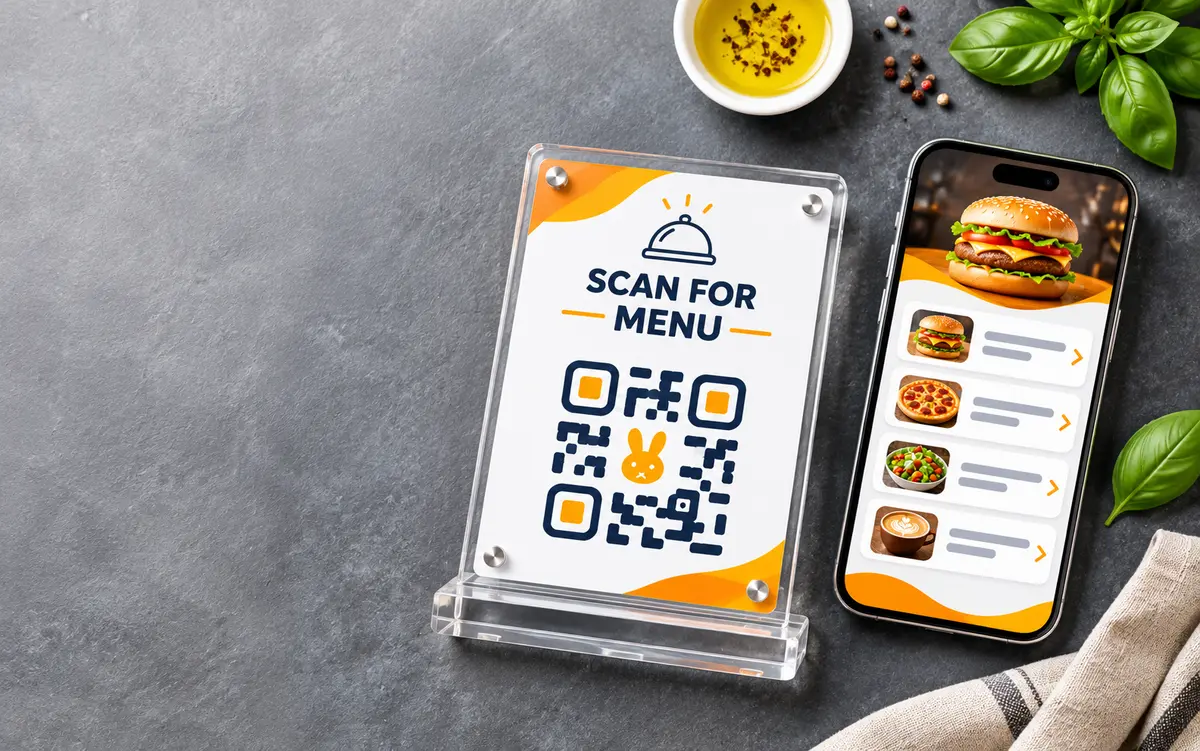
To create a menu QR code for your restaurant, upload your menu as a PDF (or link your menu web page), generate a dynamic QR code in QR Code Rabbit, add your colors and logo, then download and print it. A dynamic code lets you swap the menu later without reprinting. Built for restaurant and café owners.
Table of Contents
1. What is the fastest way to create a menu QR code?
The fastest way is a dynamic QR code from QR Code Rabbit: upload your menu PDF, style the code, download it and print it. You can start free. Here is the full picture in one passage:
A menu QR code is a QR code that opens your restaurant menu on a guest's phone when they scan it with the camera. The most reliable way to make one is with QR Code Rabbit: choose a dynamic QR code, pick the PDF type for a menu file (or the URL type for a menu page you already host), upload or paste your menu, style the code with your colors and logo, and download it as PNG or SVG. Because a dynamic code points to a short link you control, you can replace the menu behind it whenever prices or dishes change, and the printed code on your tables keeps working. Set error correction to H (30%) if you add a logo, print the code at least 2 × 2 cm, and scan it on both an iPhone and an Android phone before you print a hundred table cards.
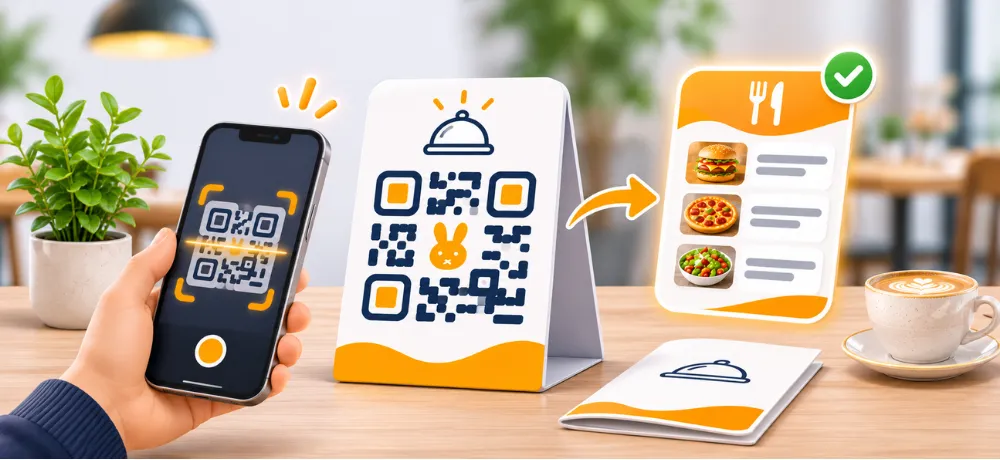
2. Which QR code type should a restaurant menu use?
Use the PDF type if your menu is a file, the URL type if your menu is a web page, and the Image type if your menu is a few photos. All three are dynamic types on QR Code Rabbit, so you can swap the menu without reprinting.
If you also want guests to join your Wi-Fi from the table, add a separate code with the Wi-Fi QR code generator rather than mixing both on one card. Our guide to making a free Wi-Fi QR code shows how.
3. How do you make a menu QR code in 6 steps?
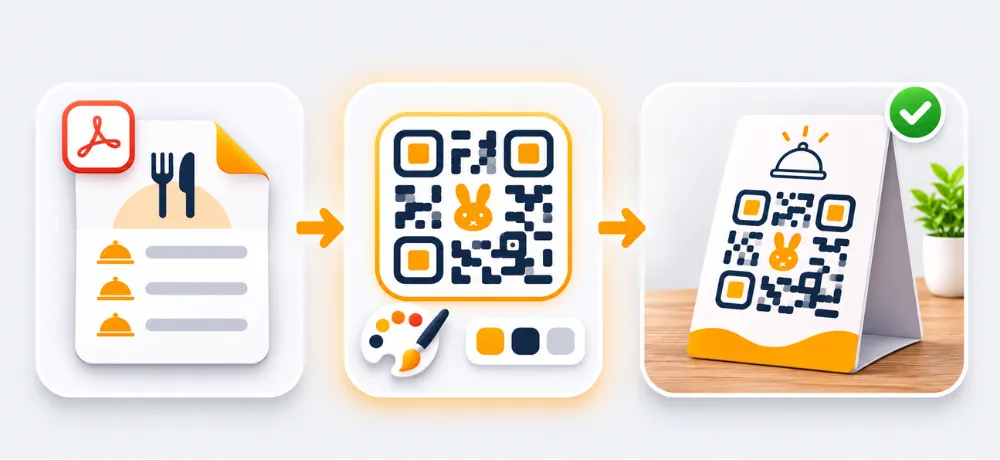
Menu QR codes take six steps on QR Code Rabbit: prepare the menu, choose dynamic and a type, add the menu, design the code, download it, then test and print. The create flow has three screens (type, content, design), so most of the work is steps 1 and 6.
Tip: Name every code by location, like "Patio table cards" and "Takeaway window". When you read the scan analytics later, you can see which placement actually gets scanned.
4. Should a printed menu QR code be static or dynamic?
Choose dynamic for any menu you will change, which is almost every restaurant. A static code locks the destination into the pattern forever, so a new menu means a new print run. A dynamic code keeps the same printed pattern while you change what it opens.
Static menu QR code
Free forever, no account needed
Works even if you close your account
Cannot change the destination: only safe when your menu page address never changes
No scan analytics
Dynamic menu QR code
Swap the menu PDF or link anytime, no reprinting
Scan analytics: cities, devices, peak hours
Pause, schedule or expire a code (handy for seasonal or event menus)
Needs an active plan to keep working
Read this before printing: QR Code Rabbit's free plan lasts 15 days and includes 3 dynamic codes with unlimited scans. Dynamic codes stop working when your plan expires, so pick a paid plan (see pricing) before you print codes you plan to keep on tables for months. If you want something that never expires, use a static URL code that points to a menu page on your own website.
For more on the trade-off, see what a dynamic QR code is and when static codes are enough.
5. How big should a menu QR code be, and where should it go?
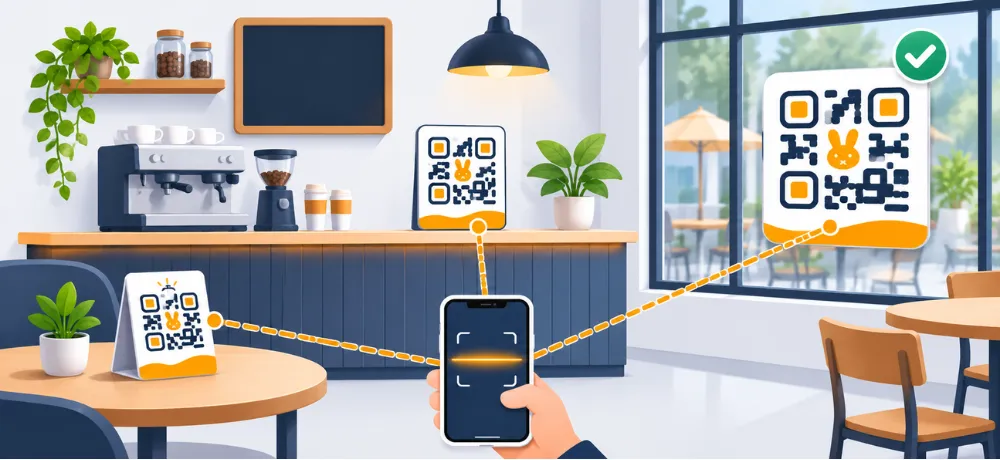
Print the code at least 2 × 2 cm (0.8 × 0.8 in) for close-range table use, and scale it up for distance: roughly 1 cm of code for every 10 cm of scanning distance. A table card read at arm's length (about 40 cm) wants a code near 4 cm; a window sign read from 2 m wants about 20 cm.
Keep a quiet zone: at least 4 modules of plain white border around the code.
Dark code on a light background scans best. Avoid putting the code over a photo or a candle-lit glossy surface.
Put a short call to action beside it, like "Scan for today's menu", so guests know what the code does.
Use matte stickers or card stock to avoid glare, and wipe table cards between guests.
Place codes where people sit: table tents, coasters, the counter, the takeaway window. Add one at the entrance for queues.
6. What mistakes ruin a restaurant menu QR code?
The most common failures are tiny print, a menu that is hard to read on a phone, and a code that stops working. Each one is easy to avoid.
Printing before testing. Scan a proof on at least one iPhone and one Android phone. Both scan natively with the camera app.
Using a static code for a menu that changes. You will end up reprinting. Use dynamic, or a static code that points to a page you control.
Letting the plan lapse. Dynamic codes stop working when the plan expires. Set a reminder before renewal.
A huge, unreadable PDF. Guests are on mobile data. Keep text large and pages few, and check that it opens quickly.
Low contrast or a heavy logo. Fancy colors are fine, but keep strong contrast and raise error correction to H (30%) with a logo.
No fallback. Keep a few paper menus for guests without a smartphone.
Safety matters too: stick codes onto your own cards, not over them, and check tables regularly, because pasted-over fake codes are a known scam. Our guide on whether QR codes are safe explains what to watch for.
7. How do you test and track your menu QR code?
Test by scanning the printed code on two phones, then track scans in the QR Code Rabbit analytics dashboard. You can also decode a code from an image with the free QR code scanner to confirm where it points.
For dynamic codes, the dashboard shows total and unique scans, scans by device type and operating system, top cities and countries, and an hourly breakdown of peak scan activity. For a restaurant, the hourly chart shows when guests actually scan (for example, whether the lunch rush justifies a second table card), and the per-code view compares placements.
You can also schedule a code to go live at a set time, set an expiry date, or pause it, which is useful for a brunch-only menu or a limited-time seasonal menu. Whichever you pick, keep the menu itself fresh: that is the real reason guests scan.
8. Menu QR code FAQ
Can I make a menu QR code for free?
Yes. Static QR codes are free forever with no signup and no watermark. Dynamic codes (needed to change the menu later) are free for 15 days with up to 3 codes; after that you need a paid plan.
Is a PDF or a link better for a restaurant menu QR code?
A PDF is quickest if your menu is already a file. A link to a mobile-friendly web page is better if you update the menu often on your site. Both work as dynamic codes on QR Code Rabbit.
Can I change the menu without reprinting the QR code?
Yes, with a dynamic QR code. Edit the PDF or link in your dashboard and the printed code keeps working. A static code cannot be changed after printing.
What size should a menu QR code be on a table?
At least 2 × 2 cm (0.8 × 0.8 in), with a plain white border of 4 modules. For signs read from farther away, add about 1 cm of code per 10 cm of distance.
What happens to my QR code if I stop paying?
Dynamic codes stop working when the plan expires. Static codes keep working forever because the content is encoded in the pattern itself.
Do guests need an app to scan a menu QR code?
No. iPhone (iOS 11 and later) and most Android phones scan QR codes with the built-in camera app, so guests just point and tap the link.
The bottom line: the easiest menu QR code for a restaurant is a dynamic PDF or URL code you can update without reprinting. Test it, size it for the distance, and keep your plan active. "QR Code" is a registered trademark of DENSO WAVE INCORPORATED.
Related Articles
12 Diwali QR Code Ideas for Shops, Families & Brands (2026)
UPI payments, WhatsApp orders, expiring offers and video blessings, with the right QR type for each
PDF QR Code Generator: Turn Any PDF Into a QR Code
Upload a PDF, design the code, and track every scan. Print size, static vs dynamic and common mistakes included.
What You Will Find on the QR Code Rabbit Blog
We publish practical guides, plain-language explainers, and occasional news about QR adoption and security. The audience is shop owners, marketers, teachers, and developers who use QR codes in real projects — not theory for its own sake.
How-to articles
Step-by-step pieces for menus, badges, packaging, forms, UPI labels, and social profiles. Most include sizing tips and a short testing checklist.
Knowledge base posts
Capacity limits, error correction, static vs dynamic architecture, and how scan tracking works — written so non-developers can follow, with enough depth for integrators.
News and security
Retail and fintech adoption stories, product updates, and reminders about quishing and safe scanning habits as QR usage grows.
Resources and templates
Campaign checklists, design consistency notes, and pointers for teams rolling QR out to many locations or via API.
New posts regularly
Browse by category — how-to, knowledge base, news, resources — or read everything on the main blog index. No paywall, no login required.
Ready to try it? Create a free QR code on QR Code Rabbit.